
The Rise of Bolt Graphics: A Threat to NVIDIA’s GPU Dominance
Summary:
- Innovative Design: Bolt Graphics introduces its ZEUS series, featuring a chiplet architecture designed for high-performance computing and gaming.
- Performance Metrics: The ZEUS GPUs promise groundbreaking performance, outpacing NVIDIA’s offerings significantly.
- Roadmap and Strategy: Bolt Graphics positions itself not as a chip manufacturer, but as an IP provider, seeking partners for production.
In the current landscape of the global GPU market, dominated by titans like NVIDIA, the emergence of new competitors has been a rarity. Notably, Bolt Graphics aims to disrupt this status quo with their innovative ZEUS series of graphics cards. As the industry grapples with stagnation, Bolt Graphics emerges as a potential game-changer.
Introducing the ZEUS Graphics Card
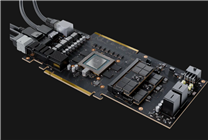
The ZEUS series consists of three variants: the 1C single core, the 2C dual core, and the 4C four core. Designed with a groundbreaking chiplet architecture, these cards excel in real-time ray tracing, showcasing capabilities that significantly outpace current market leaders. During a recent technology exhibition, Bolt Graphics highlighted its cutting-edge performance metrics, although only marketing materials accompanied the display.
The ZEUS series leverages a self-developed SIMD architecture, powered by a RISC-V core processor. The prototype utilizes a PCIe 5.0 x16 slot and is equipped with advanced LPDDR5X memory, with potential expansions via DDR5 slots. This cutting-edge design accommodates varying memory capacities: the 1C version supports up to 128GB, the 2C version accommodates up to 160GB, while the 4C variant can handle an impressive 2304GB. The power consumption ranges from 120W for the 1C version, up to 500W for the 4C model, which is designed specifically for server settings.
Unmatched Performance Metrics
The performance claims from Bolt Graphics are nothing short of extraordinary. In terms of ray tracing capabilities, the metrics are staggering:
- The 1C version reportedly offers 2.5 times the performance of NVIDIA’s RTX 5090.
- The 2C version boasts a fivefold enhancement.
- The 4C version is said to exceed 10 times the performance of its NVIDIA counterpart.
When it comes to artificial intelligence and complex computational tasks, the ZEUS 4C version reportedly achieves EM simulation performance that is over 300 times greater than NVIDIA’s flagship AI card, the B200. These statistics position the ZEUS series as a formidable contender in a market often perceived as lacking viable alternatives to NVIDIA.
Software Support and Integration
In addition to impressive hardware specifications, Bolt Graphics has announced comprehensive software support for Vulkan, DirectX 12, Unreal Engine, and Unity Engine. This level of compatibility ensures that users can seamlessly integrate ZEUS graphics cards into existing workflows, whether for gaming or professional AI applications.
Strategic Positioning and Future Outlook
Rather than positioning itself as a conventional chip manufacturer, Bolt Graphics has strategically aligned itself as an intellectual property (IP) provider, akin to established players like ARM. This means that the ZEUS GPUs will not be produced in-house; instead, Bolt seeks partnerships with organizations that are willing to license their technology for production and sale. By adopting this model, Bolt Graphics aims to accelerate its market penetration while minimizing the risks associated with manufacturing.
Despite their ambitious roadmap, including projections for customer engagements in the next few years, Bolt’s CEO has indicated that mass production may still be several years away. The firm was established in 2020 by Darwesh Singh, who previously developed a hardware-accelerated light tracing solution in 2014, and has garnered support through funding rounds in 2021 and 2022.
Conclusion: A Future Game-Changer?
As Bolt Graphics navigates the competitive landscape, the potential of its ZEUS graphics cards remains significant. The unprecedented performance claims, combined with a unique positioning strategy, could mark a pivotal shift in the GPU market. However, whether these ambitions materialize into tangible products that disrupt NVIDIA’s reign will depend on effective execution and strategic partnerships in the coming years.
In summary, while formidable challengers have historically struggled to carve out a niche against industry giants, Bolt Graphics may represent a fresh opportunity for innovation and competition in the GPU market. The future holds promise, but only time will reveal if the ZEUS series can transform from an ambitious concept into a standard-bearer for high-performance graphics technology.