
Breakthrough in Ferroelectric Materials: Observing One-Dimensional Charged Domain Walls
Summary
- Discovery of New State: Researchers have experimentally observed one-dimensional charged domain walls in zirconium oxide ferroelectrics.
- Implications for Nanoelectronics: This finding could pave the way for high-density electronic devices, including memory and AI chip units.
- Challenging Traditional Views: This study challenges the previous understanding that domain walls in ferroelectric materials are strictly two-dimensional.
The scientific research team from the Institute of Physics at the Chinese Academy of Sciences, along with the Beijing National Research Center for Condensed Matter Physics, has made a significant advancement in ferroelectric material research. Their groundbreaking findings, published in a leading journal, detail the first experimental observation of a new state of matter: the one-dimensional charged domain wall, specifically in zirconium oxide (ZrO₂) ferroelectrics.
Understanding Domain Walls
In ferroelectric materials, domain walls serve as the interface separating regions of differing polarization. These domain walls possess unique physical properties, making them highly sought after for use in next-generation nanoelectronic devices. Traditionally, domain walls in three-dimensional bulk ferroelectric crystals are interpreted as two-dimensional structures with nanometer thickness. The challenge for researchers has been to create smaller domain walls that can enhance the integration density of upcoming electronic devices.
The Unique Structure of Fluorite Ferroelectrics
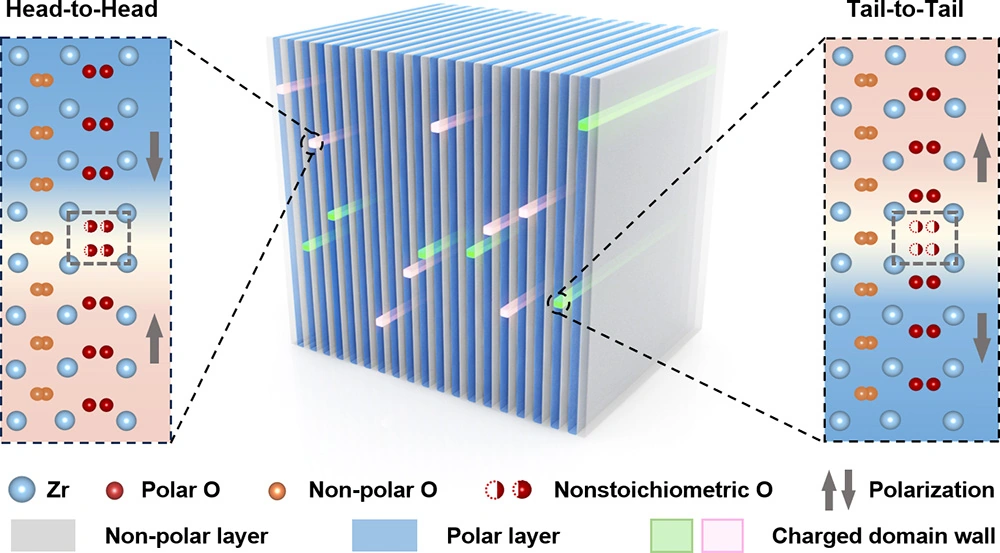
Fluorite-structured ferroelectrics, such as zirconia, feature a specialized layered architecture. In these materials, two-dimensional polar layers are interspersed with non-polar layers. Theoretical models suggest that confined within these polar layers, charged domain walls may manifest with exceptionally small size limits capable of independent movement. Nevertheless, experimental validation of these theories has remained an ongoing challenge.
Experimental Breakthrough
The research team achieved a remarkable feat by fabricating a self-supporting zirconium oxide ferroelectric film using a laser-based method. This innovative approach enabled the successful observation of both "head-to-head" and "tail-to-tail" one-dimensional charged domain walls. Notably, measurements revealed that the cross-sectional dimensions of these domain walls are confined to the subunit cell scale, approximately 2.55 angstroms by 2.71 angstroms.
The study further explores the unique mechanism of charge shielding within these domain walls, primarily facilitated by the self-adjustment of oxygen ion positions. Additionally, local electric fields were employed for the artificial manipulation of these one-dimensional domain walls, showcasing the potential for precise control in future applications.
Shifting Paradigms in Ferroelectric Research
This research sets a new precedent in the field by experimentally confirming that stable one-dimensional domain wall structures can coexist within three-dimensional ferroelectric crystals. It fundamentally alters the long-held belief that domain walls are exclusively two-dimensional phenomena. The implications of this discovery are vast, providing a fresh scientific foundation for developing high-density electronic devices that operate at extreme dimensions based on ferroelectric domain walls. Such innovations could revolutionize technologies, leading to advanced memory solutions and artificial intelligence chip units.
The Research Team
The research was spearheaded by co-first authors Zhong Hai, a postdoctoral fellow currently serving as an associate professor at Ludong University, and Wang Shiyu, a doctoral student. The study also involved significant contributions from associate researcher Zhang Qinghua, academician Jin Kuijuan, and researcher Ge Chen. Their work was underpinned by support from multiple initiatives, including the National Key R&D Program and the National Natural Science Foundation.
Conclusion: A New Era for Ferroelectric Materials
This pioneering research not only adds a new chapter to the study of ferroelectric materials but also opens up numerous avenues for technological advancements in the field of nanoelectronics. As scientists continue to explore the potential applications of one-dimensional charged domain walls, we may soon see the emergence of smaller, faster, and more efficient electronic devices that leverage this innovative understanding of ferroelectricity.
This article reflects the ongoing dedication to advancing fundamental physics, with implications that extend well beyond theoretical boundaries into the practical realms of electronic engineering and materials science. As research in this field progresses, we will likely witness transformative breakthroughs that redefine our understanding of materials and their applications in technology.