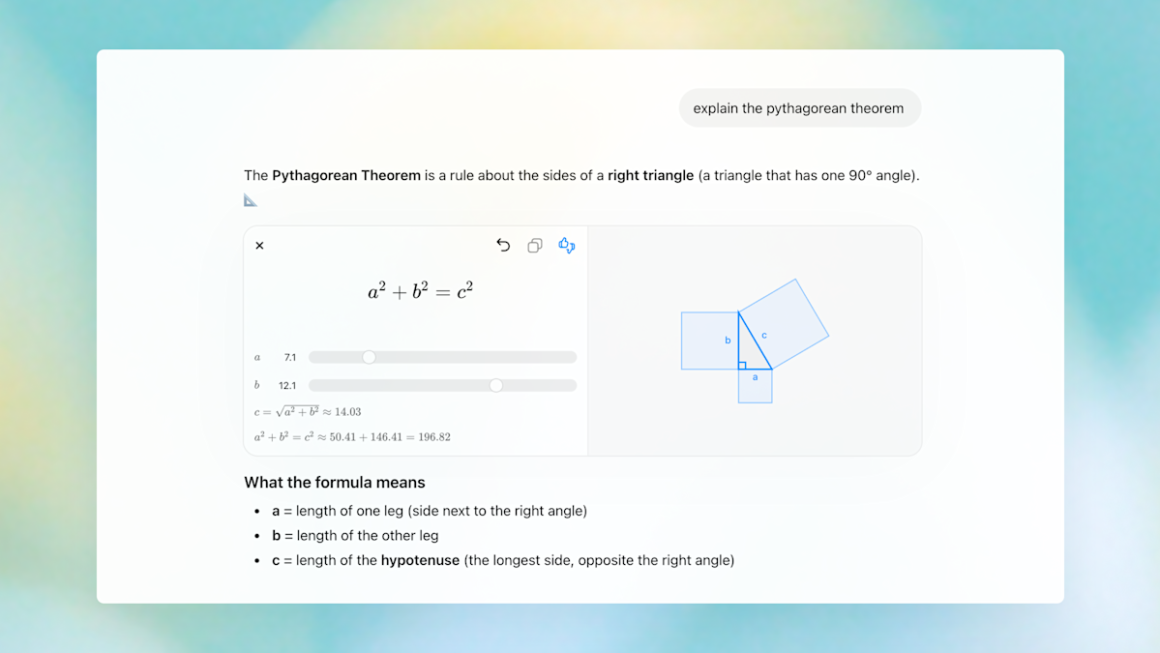

OpenAI has recently introduced interactive response features in ChatGPT, designed to aid learners by generating dynamic visuals for over 70 scientific and mathematical concepts. Starting today, users can ask ChatGPT about topics like the Pythagorean theorem and Ohm’s law, receiving visual representations that allow them to adjust variables and equations to see how changes affect outcomes. This feature is available to all users, regardless of subscription status.
This development is significant for students, particularly those in high school and college who are navigating challenging concepts in math and science. With ChatGPT’s ability to provide visual aids that can be manipulated, learners have the opportunity to engage with the material interactively. This global rollout highlights OpenAI’s commitment to education, making these tools accessible to a broad audience. The aim is to enhance understanding in fields that students often find daunting.
While ChatGPT’s interactive visuals are an innovative addition, it’s essential to consider the context of how this fits into the existing educational tools market. There are various platforms such as Khan Academy and Coursera that offer structured learning experiences alongside video explanations and quizzes. ChatGPT’s approach, however, emphasizes real-time interaction and user-directed learning. Price considerations aside, it’s crucial to evaluate the nature of support offered by these platforms: while ChatGPT is versatile and responds to open-ended queries, other platforms may provide more structured curricula that some learners might prefer.
For students who thrive on immediate feedback and exploration of concepts, the interactive features of ChatGPT could greatly enhance their learning experience. However, those who require more guided lessons or comprehensive curricula might find platforms like Khan Academy more beneficial. Additionally, it’s worth noting that while the new feature enriches the ChatGPT experience, reliance solely on AI for complex subjects might not replace the personalized instruction that some learners still need. Weighing the pros and cons is essential to determine if this tool aligns with one’s educational needs.
Source:
www.engadget.com