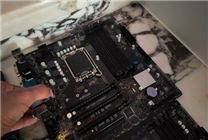

ASRock H610M Combo Motherboard: The Ultimate Flexibility for Memory Users
- ASRock unveils a groundbreaking motherboard supporting both DDR4 and DDR5 memory.
- Compatibility with Intel’s 12th to 14th generation processors and LGA1700 socket.
- Users can transition from DDR4 to DDR5 seamlessly, optimizing their computing needs.
ASRock, renowned for its innovative computer hardware, has unveiled the H610M Combo motherboard at CES, which showcases a remarkable dual-memory architecture.
The standout feature of this motherboard is its unique configuration: it includes two DDR4 slots alongside four DDR5 slots, all within a Micro-ATX form factor. This design offers a flexible upgrade path amidst the fluctuating global memory market, where DDR5 prices remain high, making it challenging for many users to upgrade.
The H610M Combo utilizes the LGA1700 socket to support Intel’s 12th, 13th, and 14th generation Core processors. This compatibility allows users to initially employ existing DDR4 memory, thus managing costs effectively. As DDR5 prices drop or as higher performance needs arise, users can transition effortlessly to newer DDR5 memory without the necessity of replacing the entire motherboard.
The specifications for memory are impressive: DDR4 supports up to DDR4-3800 and can handle a maximum of 64GB, while DDR5 supports speeds of up to DDR5-4800 and can accommodate up to 96GB. Users should note that both memory types cannot be utilized simultaneously.
ASRock’s commitment to innovation is evident in this motherboard. Their approach of combining both DDR4 and DDR5 memory slots is a rarity in the industry, as very few manufacturers venture into this territory. It is noteworthy that AMD’s Ryzen series does not support DDR4, limiting competition within certain segments.
In conclusion, ASRock’s H610M Combo motherboard addresses both current and future needs of users, especially in a rapidly changing memory landscape. The flexibility of mixing memory types on a single board positions ASRock as a leader in the realm of motherboard design, offering users the best of both worlds—value and performance.
[End of Article]