
The Evolution of AMD’s Processor Line: A Deep Dive into Ryzen 10 and Ryzen 100 Series
Summary:
- AMD has reintroduced its Zen2 and Zen3+ architectures with new Ryzen 10 and Ryzen 100 series processors.
- These new releases offer competitive specifications aimed at both budget-conscious consumers and mid-range users.
- Despite naming challenges, AMD continues to innovate and adapt to market demands.
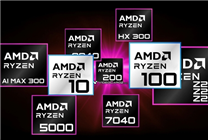
On October 27, Kuai Technology highlighted AMD’s latest developments: the launch of Ryzen 10 and Ryzen 100 series processors. This move demonstrates AMD’s strong foothold in the semiconductor market, allowing for product variations that may lead to confusion among consumers due to similar naming conventions and multi-layered architectures.
Intel, its chief competitor, faces a similar complexity in its product offerings, making it a common pain point for both manufacturers and consumers alike.
Reintroducing Legacy Architectures
AMD has brought back the previously utilized architectures of Zen2 and Zen3+, unveiling two significant processor series. This strategy showcases their ability to adapt older technology for current market requirements while maintaining relevance among diverse user bases.
Ryzen 10 Series: The Affordable Powerhouse
The core designation for the Ryzen 10 series is "Mendocino," which made its debut back in September 2022 as part of the Ryzen/Athlon 7020U product lineup. This entry-level series focuses primarily on budget notebooks, particularly Chromebooks.
Specifications include:
- Manufacturing Process: 6nm
- Architecture: Zen2 and RDNA2
- Power Consumption: 8-15W
- Integrated Graphics: Radeon 610M GPU
- Support: LPDDR5, PCIe 3.0, USB 3.2 10G
Two primary models have been rebranded and launched:
- Ryzen 5 40 (previously Ryzen 5 7520U): Features 4 cores, 8 threads, with frequencies ranging from 2.8 to 7.3GHz and 2MB L2 cache alongside 4MB L3 cache.
- Ryzen 3 30 (previously Ryzen 3 7320U): Similarly configured with 4 cores and 8 threads but with frequencies of 2.4 to 4.1GHz.
The Ryzen 100 Series: Reviving Advanced Performance
The Ryzen 100 series is characterized by its code name "Rembrandt," originally unveiled in early 2022 within the mobile Ryzen 6000 series. These processors have been reintroduced under the Ryzen 7000 series name in a new form.
Specifications for the Ryzen 100 series also utilize a 6nm manufacturing process, featuring:
- Architecture: Zen3+ and RDNA2
- Integrated Graphics Options: Radeon 680M with 12 graphics units and Radeon 660M with 6 units.
- Support: DDR5, PCIe 4.0, USB 3.2 10G
The lineup consists of five powerful models that cater to a range of needs:
- Ryzen 7 170: Comparable to Ryzen 7 7735HS, it offers 8 cores, frequencies from 3.2 to 4.75GHz, and a thermal design power of 35-54W.
- Ryzen 7 160: Equivalent to Ryzen 7 7735U, also equipped with 8 cores and a frequency range of 2.7 to 4.75GHz, with a thermal design power of 28W.
- Ryzen 5 150: Known as Ryzen 5 7535HS, it features 6 cores, operates between 3.3 and 4.55GHz, and runs within a 35-54W thermal envelope.
- Ryzen 5 130: This model (Ryzen 5 7535U) offers a 6-core setup with frequencies between 2.9 and 4.55GHz and a thermal design power of 28W.
- Ryzen 3 110: Also identified as Ryzen 5 7520U, it has 4 cores with a frequency increase of 200MHz from its predecessor, maintaining a thermal design power of 15W.
Navigating the Naming Conundrum
While AMD’s strategy of reintroducing older architectures may offer advantages in terms of familiar performance benchmarks, the accompanying naming conventions can be overwhelming for consumers trying to choose the best option for their needs. The integration of various models under the Ryzen umbrella demonstrates a commitment to variety at the price of clarity.
Conclusion
AMD’s launch of the Ryzen 10 and Ryzen 100 series illustrates its agility in responding to market demands while carrying forward the legacy of its architectures. However, the challenge of managing communication around product naming remains an area for improvement. As the tech landscape continues to evolve, AMD’s strategic decisions will play a crucial role in determining its market position and consumer perception.
With these recent launches, AMD reaffirms its dedication to delivering value while navigating the complexities of a competitive market. As consumers look for budget-friendly yet powerful options, AMD appears poised to maintain its edge in the ever-competitive CPU arena.