
The Legacy of ENIAC: Celebrating the World’s First General-Purpose Computer
Summary
- ENIAC, developed in 1946, was the first general-purpose digital computer, revolutionizing computing speed and capability.
- Despite its monumental achievements, ENIAC’s technology has become outdated compared to modern devices.
- The machine was complex, requiring extensive maintenance and manual programming, reflecting the early challenges of computing technology.
On February 15, 1946, a landmark event unfolded in the realm of technology with the birth of the Electronic Numerical Integrator and Computer (ENIAC), the world’s first general-purpose digital computer. While it was in fact the second electronic computer—following the Atanasoff-Berry Computer (ABC)—ENIAC’s significance lies in its ability to be reprogrammed for various computational tasks, a groundbreaking advance for its time.
ENIAC emerged from the United States military’s urgent need during World War II, specifically to calculate the ballistic trajectories necessary for artillery operations at the U.S. Army’s Ballistic Research Laboratory. Designed and constructed at the Moore School of Electrical Engineering at the University of Pennsylvania, its notable creators included visionaries such as John von Neumann, engineers J. Presper Eckert, John Mauchly, and the Chinese scientist Zhu Chuanju. Remarkably, Eckert was just 25 years old during the project.
This pioneering machine could perform approximately 5,000 additions or 400 multiplications per second—over 1,000 times faster than comparable equipment from its era and an astonishing 200,000 times quicker than manual calculations. Tasks that used to require 12 hours with hand-cranked calculators could now be executed in just 30 seconds, marking a significant leap in efficiency.
ENIAC’s remarkable computational capabilities were not limited to artillery; it also played a role in hydrogen bomb calculations, ballistic missile trajectory analysis, and even weather forecasting. Ironically, while ENIAC’s power was revolutionary at the time, today’s commonplace devices such as electric toothbrushes possess vastly superior computing capabilities.
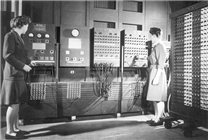
This monumental machine consisted of an intricate assembly featuring around 8,000 vacuum tubes, 70,000 resistors, and 10,000 capacitors, arranged in a U-shaped structure occupying 30.48 meters in length, 6 meters in width, and 2.4 meters in height. Weighing in at an impressive 30 tons, ENIAC operated in a dedicated room approximately 9 meters by 15 meters, consuming about 150 kilowatts of power. Its initial cost was around $480,000—an astronomical sum in 1946.
Today, remnants of ENIAC’s original components can still be viewed in the Moore Building, including its loop arithmetic unit, main programming unit, function tables, and accumulators—each a testament to the monumental engineering efforts involved.
However, programming ENIAC was far from straightforward. It required meticulous wiring through a complex power strip and the manipulation of three portable function tables, each equipped with 1,200 ten-way switches. This painstaking process demanded a well-trained team, many weeks of effort, and rigorous testing to achieve reliable operation.
ENIAC’s operational methodology involved physically plugging and unplugging cables to set programming tasks, necessitating frequent manual adjustments for different computing jobs, which complicated usage. Moreover, due to the substantial reliance on vacuum tubes, which burned out daily, the machine was operational only about half of the time, due to continuous maintenance requirements.
Eventually, on October 2, 1955, ENIAC was taken out of service as successors utilizing binary stored program architecture—most notably EDVAC—began to emerge, paving the way for more advanced computing solutions.
The journey of ENIAC offers a compelling snapshot of the early days of computing, illustrating both the groundbreaking achievements and the limitations faced by engineers and scientists of that era. Its legacy endures as a pivotal milestone in the evolution of technology.