
Summary:
- A Brazilian hardware modification team successfully repaired a severely damaged RTX 5070 Ti graphics card, breaking world records in the process.
- The repair involved creative engineering techniques, rebuilding the power supply system and optimizing performance to achieve remarkable results.
- Key performance metrics were significantly improved, showcasing the team’s expertise in hardware restoration.
Innovative Hardware Restoration: The Remarkable Journey of the RTX 5070 Ti
In the world of graphics cards, severe damage often leads to inevitable scrapping. However, for Paulo Gomes and his esteemed Brazilian hardware modification team, such challenges are merely invitations to push the boundaries of innovation. Recently, the team undertook the ambitious task of repairing an RTX 5070 Ti that had suffered extensive damage, including a hole in its PCB (Printed Circuit Board). Not only did they breathe new life into this once-defunct graphics card, but they also shattered existing performance records in the process.
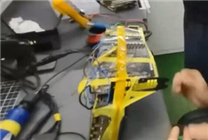
The initial condition of the graphics card was dire, featuring a completely failed power supply module and significant damage to the board itself. Displaying ingenuity, the team utilized an ASUS RTX 2080 Ti PCB as the foundation for manually reconstructing the power supply system through intricate wiring methods.
Upon commencing repairs, the team’s initial output was limited to low resolution and exhibited a voltage drop of around 400mV. At this point, the performance of the card was comparable to that of the RTX 3070, and its PCIe channel was only recognized as 4.0 x4, significantly restricting its capabilities.
During a comprehensive seven-hour live stream, the repair team, in collaboration with Enzo Túlio from the 1155 do ET channel, documented their systematic approach toward overcoming various hurdles. These encompassed initial signal output abnormalities, conflicts with Windows drivers, and considerable voltage drops that impeded performance.
Through meticulous adjustments, the team was able to repair multiple critical power supply paths, notably the NVVDD and MSVDD lines. This effort remarkably reduced the voltage drop under load from 400mV down to a mere 30mV, demonstrating the team’s technical prowess.
In a further bid to optimize performance, the computing platform was transitioned from a 13th generation Core i5 (PCIe 4.0 x4) to a Ryzen 5 3600 (PCIe 3.0 x16). This strategic change effectively doubled the bandwidth to 16GB/s, setting the stage for advanced performance testing.
Temperature management was a significant concern throughout the process. Extreme heating was observed during tests, with core temperatures soaring from 50°C to an alarming 80°C in the span of a second. Even the power supply wire was nearing 100°C—a clear indication of the challenges the team faced. Nevertheless, the diligence and persistence of the team culminated in astonishing results.
With ongoing optimization, they successfully elevated the GPU frequency of the repaired RTX 5070 Ti to an impressive 3.23GHz. Additionally, the memory frequency comfortably reached 34 Gbps. In the Unigine Superposition 8K test, the performance score surged from 8,400 points to a remarkable 11,106 points, eventually reclaiming the top position on HWBOT with an impressive score of 11,150 points—a full testament to the team’s dedication and technical ingenuity.
With aspirations for further refinement, the team hinted that under optimal heat dissipation conditions, the video memory could potentially reach speeds of 36 Gbps, highlighting their relentless pursuit of excellence.
This extraordinary achievement not only showcases the expertise and innovative spirit of Paulo Gomes and his team but also emphasizes the potential for repair and optimization in the field of hardware modifications. As technology continues to evolve, stories like this inspire both enthusiasts and professionals alike to explore the limits of what is possible.
In conclusion, the remarkable restoration of the RTX 5070 Ti has set a new benchmark in the realm of hardware repairs, merging creativity with technical skill and effectively proving that even the most damaged components can be resurrected to achieve greatness. As the line between damaged and functional blurs, the future of graphics technology may be more innovative than we ever imagined.